Showing posts with label 3 Questions With. Show all posts

Thursday, April 20, 2023

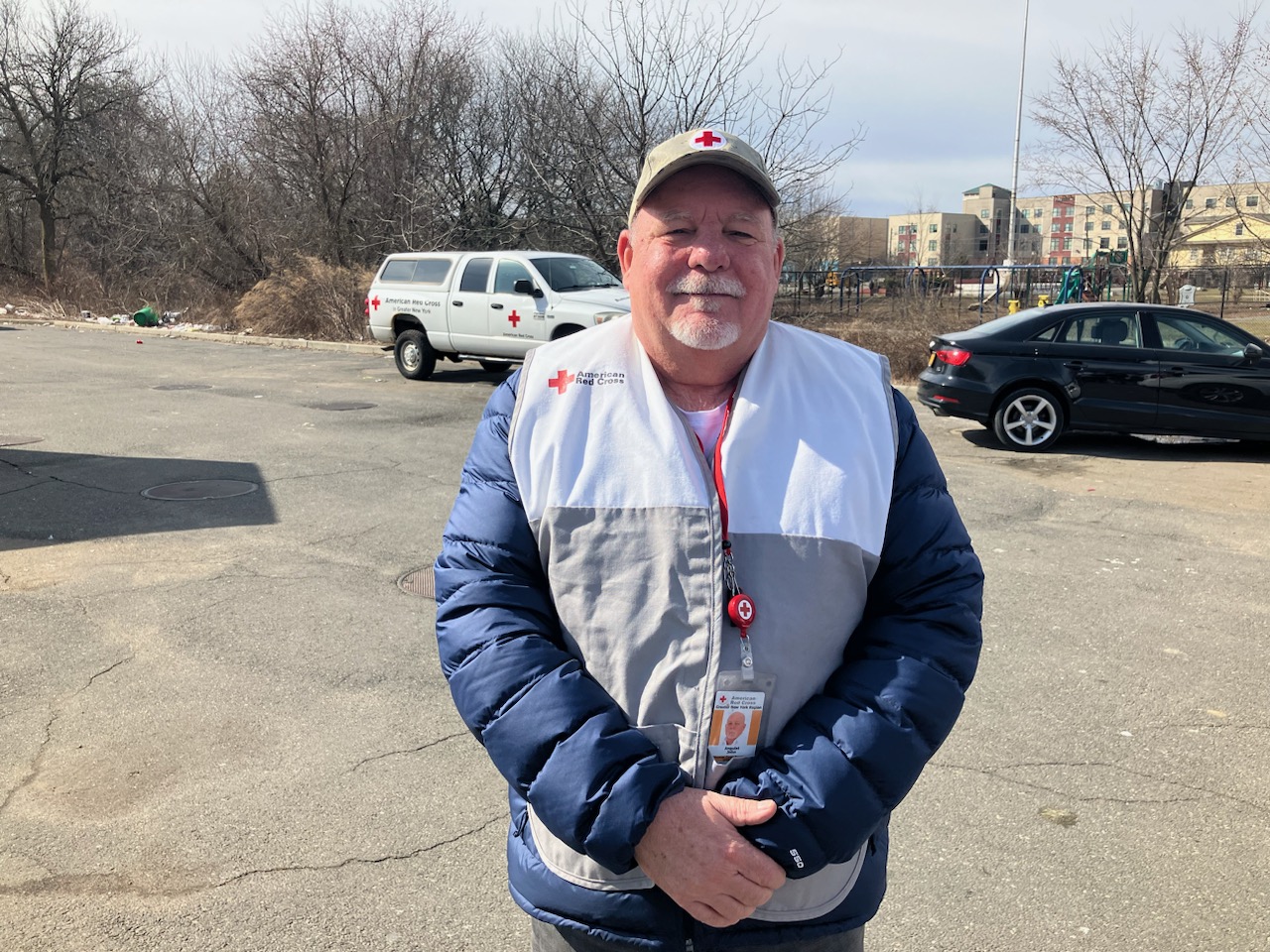
“Three Questions” with Red Cross Volunteer John Angulat


By Erianne Lewis, American Red Cross in Greater NY

"Three Questions” is an American Red Cross in Greater New York blog series featuring staff, volunteers, and partners who help carry out our humanitarian mission. Through these short interviews, we hope to shine a light on our different programs and get to know those who make this work possible.

Born and raised on Long Island and now a resident of Westchester County, volunteer John Angulat joined the Red Cross in 2018. After retiring six months ago, Angulat now thoroughly enjoys almost a fulltime volunteer role. Angulat is a Disaster Action Team (DAT) team member, which means that he provides relief and compassion to residents after local disasters.

What led you to join the Red Cross?

There was a desire to volunteer. But I think, without sounding too altruistic, it was self-reflection. I somewhat realized that I had a pretty good life. I didn't grow up wealthy: working class mother and father. When I think of the state of the world, and what people go through, in the grand scheme of things I didn't do too badly. And it was just a desire to just pay a little back. I just started feeling guilty about not being engaged. I just didn't want to take life for a ride anymore. So, I said: “Well, I'm gonna volunteer.” I didn't actually start out with the Red Cross. There's a website that's called Volunteer New York, and it's a listing of all the volunteer opportunities that are available in the area…it's almost like a help wanted listing. I was doing one-off volunteer opportunities, sometimes with photography, sometimes something else. And then one day I saw an advertisement that Red Cross was looking for Disaster Action Team responders, and it was in my area. So, I said to myself, “I'll try it,” and never looked back.

What is a moment you will never forget from your time with the Red Cross?

Me and a partner had responded to a what we call a multi-family fire. A number of people were profoundly affected by the fire. We were just trying to be as nice as we could to the people, and as kind as possible. One of the worst things you can go through, other than losing loved one, is losing your home. We were working with them for quite some time, just trying to get them calmed down. When all was all said and done, we packed everything up. As I walked down from the porch to the sidewalk, there were crowds of people. And as I was walking to my car, somebody started clapping and then everyone else was clapping and I knew that they were clapping for us. I’m still moved by it. It kind of hammered home what you're doing for these people. In the long term they've still got a long process to go through. But at least you've gotten them through the next few days and pointed them in the right direction. It was touching, it really was. I don't think I’ll ever forget that.

What would you say to encourage someone to become a Red Cross volunteer?

Try it. You have nothing to lose. You are a volunteer. There’s a whole different mindset when you are doing volunteer work, rather than when you are being paid by someone. Just a different mindset, a different approach. What could go wrong? You try, you don’t like it, you just say “Hey it’s not for me.” But at least you can say, “I tried it.” That’s what I would tell anyone. Try it and I think you’ll like it. I really do.

Thursday, March 30, 2023

“Three Questions” with Red Cross Volunteer Ed Mechmann

By Erianne Lewis, American Red Cross in Greater NY

"Three Questions” is an American Red Cross in Greater New York blog series featuring staff, volunteers, and partners who help carry out our humanitarian mission. Through these short interviews, we hope to shine a light on our different programs and get to know those who make this work possible.

Ed Mechmann, a fulltime attorney from Yonkers, N.Y., joined the Red Cross after the 9/11 terrorist attacks. He began volunteering with his wife at a Respite Center near Ground Zero. A few years later, Mechmann joined the Red Cross Disaster Action Team (DAT) supporting residents affected by local disasters across Westchester County. Mechmann’s flexible work schedule allows him to devote two days a week to the Red Cross, for which we thank him!

Is there a memory from your time with the Red Cross that particularly sticks out to you?

Yes, there’s a lot. I mean the Respite Center memories were very vivid. When the workers would come in, they were working on the pile. They were trying to recover bodies, and that was very intense.

One of my most remarkable memories with DAT was when we responded to a fire in Yonkers, it was downtown Yonkers, an old building, and everybody was burned out. My wife Peggy and I, and another volunteer were in the hallway of the building interviewing the clients [affected residents]. The fire was so bad that the roof had been obliterated, so we were standing there in the hallway and it’s snowing on us. We are interviewing the clients and they are very distraught. I remember this one woman that I was interviewing, and she starts crying and I gave her a hug and it was just a very vivid memory for me.

What would you say to someone who is considering volunteering with the Red Cross, but might be hesitant?

I would say, first of all, there are so many good volunteers that will help you along. You are never by yourself. If you are out on a fire, there is always someone with you and almost always someone who has a lot of experience. You are never going to be alone. There’s always going to be people to help you. We really put a lot of effort into helping volunteers move along and get more experience, feel more comfortable. The satisfaction you get from helping people in their darkest hour is really a great experience. I’ve done volunteer work in a lot of other places, and you rarely get the kind of person-to-person help. It’s direct personal contact with a person who needs help. That again is just very emotionally and spiritually fulfilling for a lot of people.

What else would you like people to know about volunteering with the Red Cross?

I think it’s great knowing that in the Red Cross, I’m a little volunteer here in Westchester, but we are active around the world. My wife deployed after Hurricane Katrina, down to Louisiana. A lot of our fellow volunteers that we work with all the time, they deploy. It’s just a great thing knowing I’m a little volunteer here, almost in my own neighborhood, but there are people just like me all around the world, who are doing the same thing with the same symbol…we are all in a fellowship of helping others. That principle of humanity, that’s at the heart of the Red Cross mission, is just amazing to me to think of. I’d say that to people: “You are getting into something that is so big and is so well respected.” I’ll tell you, when we show up to a fire site, we get a feeling of that, because the firemen all say, “The Red Cross is here,” and the police say “Oh, thank God the Red Cross is here,” and the clients say the same thing. They know that when the Red Cross is there, we are there to help. That’s around the world, but also in your own little neighborhood.

As more people rely on the American Red Cross for help, the need for compassionate volunteers has never been greater. Join our disaster team and make a difference in people’s lives

Tuesday, November 26, 2019

Three Questions: Raul Rivera Nuñez

By Maria Sievers, American Red Cross in Greater NY

"Three Questions" is an American Red Cross in Greater New York blog series featuring staff, volunteers, and partners who help carry out our humanitarian mission. Through these short interviews, we hope to shine a light on our different programs and get to know those who make this work possible.

Raul (second to the left) with his Red Cross team in Bahamas 
Raul Rivera Nuñez, who currently serves as Regional Director of Planning, Readiness, and Situational Awareness at the American Red Cross in Greater NY, first joined the organization in 2009. During his time here he has been deployed several times to national and international disasters. He recently got back from a 5-week deployment to the Bahamas where Hurricane Dorian devastated parts of the country in early September. He defines this experience as one of the most challenging one he has ever had.

What kind of impact did the storm have?

Hurricane Dorian was one of the strongest to impact the islands. A month after the storm impact, there were still 600 hundred people missing.

You hear stories, unbelievable stories of what people had to do to survive. There was one about this man, that was trying not to get swept out by the storm and a piece of flying debris severed his arm. He lost his arm trying to hang on to a tree, so he didn’t get swept out by the storm.

During my time there I quickly became very impressed with the Bahamian people’s resiliency. They are incredibly resilient, resourceful and very warm, even after having gone through something as traumatic as this. As they share their hurricane survival experiences, they always end the story with an intent of determination, energy, adaptability, courage, among other admirable qualities.

What was your specific role in Bahamas?

I was doing a bilateral role, as a shelter/settlement team member. The American Red Cross and the Bahamas Red Cross had a previous relationship, which was established way before this disaster arrived. Me and two other folks [from the American Red Cross] got deployed to do assessment and recommendations. There were two components: One, how can a shelter experience the increase in the number of evacuees? Second, once the evacuees move on to transitional sheltering, what are some recommendations that they need to have the most positive experience possible? And three, also make recommendations for how the Bahamas Red Cross can be a greater stakeholder in the next disaster relief operation

Day to day I’m doing a lot of coordination, so I definitely need to talk to a lot of people, staying on top of the current developments and what the situation awareness is and just make that as part of our overall report. We are also assisting the cash distribution team, they are distributing cash to the most vulnerable people, so we lend a hand in assisting and setting that up. We are working long hours, I would say at least 12 hours per day.

What do people in the US not know about the situation in the Bahamas?

The Bahamas is a bunch of islands, it’s about 700 islands, so the logistics of working here is quite different than working on the mainland or any other type of scenario. Being a chain of islands, there are a limited number of ways that assistance can enter each island, for debris clean-up to be completed, and for how people can get back to assess home damage or do repairs, etc.

Livelihoods have also added complexity to the impact, as a great number of people will not have a job to get back to when they return to their respective islands. All in all, there was the immediate impact trauma that affected the Bahamian people; but also, as time goes by, there will be an longer-term impact on them. It will take time for them to get back to their island, time to get the opportunity to rebuild, time to find/train for a new job, and time to return to some decent level of normalcy.

All of the deployments are different because of the nature of the specific incident, but this one has been one of the most challenging ones.

Thursday, August 23, 2018

"Three Questions With"… IT Specialist/International Disaster Response Delegate Andy Li

“3 Questions With…” is an American Red Cross in Greater New York blog series featuring staff, volunteers, and partners who help carry out our humanitarian mission. Through these short interviews, we hope to shine a light on our different programs and get to know those who make this work possible.

Andy Li has been with the Red Cross for nine years working as an IT Specialist at the Greater New York HQ. He recently joined the international roster as an International Disaster Response Delegate following a competitive application process and two intense trainings. In his new role, he will have the opportunity to deploy internationally while specifically serving in an IT capacity.


What is an International Disaster Response (IDR) Delegate?

IDR roster members with the American Red Cross deploy in support of Red Cross/Red Crescent Movement disaster response operations in very distinct roles. I’m part of the ITT (Information Technology and Telecom) group which is one of the areas that the American Red Cross specializes in. [Other areas include Relief, Cash Transfer and GIS/Info Management.] As ITT we’d be going out to support the Federation or host National Society with technology solutions such as communications network setup or internet connectivity. American Red Cross is one of five countries that specializes in ITT, along with Finland, Denmark, New Zealand, and Spain.

I first heard about the International Disaster Response roster and the IT specialization in 2010 on my first deployment in Tennessee. While there, I worked with the DST [Disaster Services Technology] manager, who happened to be on the international roster. That’s when it originally piqued my interest because I found out I could deploy and do disaster relief with a technology element to it.

You took part in two trainings, what were they like?

The first was a week-long training held in Maryland in April and was facilitated by the Federation [IFRC], ICRC and American Red Cross. Our instructors were from Canada, Australia and the US and we also had participants from all over the American Red Cross and from Haiti, Panama, Bangladesh and Nepal. It prepared us for international deployments and familiarized us with the whole Red Cross/Red Crescent Movement and their roles in disasters or conflicts. It was an awesome training because I hadn’t been exposed to the Movement or the type of work and programs other National Societies do.


The second was a technical ITT training at a ranch in Arizona and it was kind of in the middle of nowhere, about ten miles from the Mexican border. It was great to have the entire American Red Cross ITT group get together in the same place at the same time, so it was awesome to meet my new teammates and spend the week learning and bonding with them.

We learned to work with a variety of different technologies including VSATs. A VSAT is piece of equipment that can provide telecommunications connectivity via a satellite connection in a remote location. We also worked with network equipment such as routers and switches, as well as radio and communications equipment.


How does the thought of being deployed internationally make you feel?

I’ve done local deployments in New York City, regional deployments in New York State and the Northeast, as well as National deployments. International seems like the next step. I feel like the stakes are higher internationally, so I am anxious but excited to be a part of the international community. I feel like you work at an organization like this for that type of opportunity.

Thursday, August 9, 2018

Three Questions … with ECC Representative/Dispatcher Karenine Leveque

“3 Questions …” is an American Red Cross in Greater New York blog series featuring staff, volunteers, and partners who help carry out our humanitarian mission. Through these short interviews, we hope to shine a light on our unique programs and get to know those who make this work possible.


Karenine Leveque, a resident of Uptown Manhattan, joined the American Red Cross in Greater New York four years ago as a volunteer with the Emergency Communication Center (ECC) team and, soon enough, became a full-time employee working as an ECC Representative/Dispatcher on the 6 A.M. – 2 P.M. shift. She is responsible for fielding calls and coordinating response efforts across New York City, Long Island, the Lower Hudson Valley, New Jersey and parts of upstate New York.

What is it like working for a 24/7 operation responsible for ensuring the timely dispatch of Red Cross relief?

I think it takes a special person to work in the ECC. You need to be flexible because you get all sorts of calls: from clients [individuals affected by local disasters] and calls that aren’t all related to disasters.

It’s not for everyone. You need to be able to multitask. There’s a lot going on in there. However, you have downtime and you have times where it’s crazy. You can have, for instance, eight jobs open [local disaster responses going on] at the same time.

When you’re alone and you’re juggling multiple jobs and the calls are coming in, that’s a challenge. But I love it. I love it. I love the fact that what I’m doing is making a difference in someone’s life. I don’t even consider it going to work. That’s the way I look at it. I consider myself lucky because not a lot of people get to say, “I love my job.”

Can you walk me through the steps from when you find out about an incident to the end of the response?

For instance, I just had a fire come in. Once you have a fire, we visit this City website that keeps populating the information about the fire for us. It will tell you the size of the fire (which you need to have), the floor the fire is on, and what kind of dwelling it is. You need to know all of that. You need to know the battalion number of FDNY responding to that fire and you need to know at what time it started. All of that needs to be documented in our incident report and once we have all of that, then we can conclude that we have verified that fire and that we need to respond.

We assign the incident to our team members who will respond in person on scene. As they’re leaving the chapter, they let us know that they are en-route as a unit. On their way there, if there is traffic, they have to let us know and when they arrive on scene, they have to let us know, and within 15 minutes they need to give us a preliminary report. Every 15 minutes they’re supposed to communicate with us and let us know where they are, what they’re doing, and what’s happening.

They have to do a damage assessment to the affected units, and if somebody wants assistance, we have to know that. After all of that is done, they let us know that they are leaving the scene. If we have another incident for them, we assign them again. If not, we ask them to come back to the Chapter.

Throughout this process we are also sending internal updates, dispatching additional staff when needed, booking hotel rooms for clients, if needed, and ensuring the debit cards we give to clients are loaded with money.

Can you tell me about your interactions with clients? Does one interaction stick out as the most memorable?

There was a client who was from my home country of Haiti. I was actually off-shift and I got a call from a responder, we’re friends, to help translate into Creole and even though we have a line for people who can translate, she called me. I said, “Why are you calling me? Why don’t you call the translation line?” And she said, “You know, the way I’m seeing this lady, I just don’t know if that’s the best way to help her. Since I know you speak the language I think it will be more personable if you could speak with her.” It turns out that it was better than putting her through to the line because she had no understanding of what was happening to her. She was being vacated and she had a baby and the baby was sick. She was crying, hysterical and everything. So I was explaining to her why we were there, what we were going to do for her, and I was explaining to her how, come Monday, she would follow up in person. I even explained to her about the recovery process and it turns out everything went well for her. And she even called back to say thank you.

Monday, July 16, 2018

Three Questions With…CPR/First Aid Expert and Actress Lipica Shah

“3 Questions With…” is an American Red Cross in Greater New York blog series featuring staff, volunteers, and partners who help carry out our humanitarian mission. Through these short interviews, we hope to shine a light on our different programs and get to know those who make this work possible.

Lipica Shah joined the American Red Cross in Greater New York ten years ago as a part-time, on-call CPR/First Aid instructor. Today, Shah serves as a volunteer instructor and as a CPR and First Aid spokesperson. She is also a full-time actor. As part of her Red Cross career, Shah has done demos on various television programs including The Dr. Oz Show, The Martha Stewart Show, the TODAY Show, Good Day NY (and many more) to share vital life-saving information and encourage viewers to learn CPR and First Aid.

What are a few things everyone should know about CPR/First Aid, even if they can’t make it to a class?

My first thing is that anybody can learn first aid. Anybody can learn CPR. There is no barrier to learning these skills because it’s so easy! And the second thing is, even if you are unable to help directly, there are still things you can do to help someone—calling 911 or meeting the ambulance or just keeping the area safe and preventing people from crowding the person—and there are so many things that you can do. But first aid response sort of relies on a community to recognize that there is a problem and then take action collectively to figure out how to solve it.

What is the most memorable television experience you’ve had promoting CPR/First Aid skills?

They’ve all been so fun. I’ve done so many news segments. There was one I did on the Dr. Oz Show that was particularly fun because it was about kitchen accidents. So they actually built me a prosthetic finger. I had a whole day where I went in and got a mold made of my finger so that I could actually slice a piece of my finger off. And that was obviously traumatic and wonderful, but also a useful demonstration. So that one was really fun for me.

I would say the most meaningful was the most recent Dr. Oz I did, with Bob Harper, one of the personal trainers on The Biggest Loser. He was talking about how he was the most fit person ever and yet he had a heart attack when he was at the gym. Doctors were convinced that if nobody had known had to use an AED, he would have died. So we did this giant AED demonstration with 30 participants and taught them how simple it is to actually use and that if you take a class then you’re certified to use it. And it was really great to have this personal story paired with the training because that really hit home for some people. You never think you’re going to need to use it, but in this case it actually saved someone’s life.


What do you love most about doing demonstrations on-air?

The most exciting part is that I found a way to blend my two worlds. Because I’m definitely an actor first and it was really cool to figure out a way to use those skills in support of the Red Cross’s mission because I’m quite passionate about preparedness, health, and safety, and I feel very strongly that CPR and First Aid are skills that everybody should know and that anybody could be called upon to use at any moment. And that it’s better to know and have this knowledge and never need it than be in a situation where you have no idea what to do. So it was really cool for me to be able to blend these two passions of mine and find a way to use them.

Find a Red Cross CPR or First Aid Class: https://www.redcross.org/take-a-class

Download the free Red Cross First Aid App from iTunes, Google Play, or Amazon Marketplace.

Check out some of Lipica's other segments on The Martha Stewart Show and the TODAY Show.