Wednesday, March 21, 2018

Red Cross Month Volunteer Profile: Deepak Shenoy

by Stan Frank 

For over 60 years, the President of the United States has designated March as American Red Cross Month. It is a month when we celebrate our volunteers and supporters who make the mission of the Red Cross a reality.

This month, we are taking a moment to celebrate the volunteers who raised their hands in 2017 to support an unprecedented year of disasters across the country and around the world. From natural catastrophes including hurricanes and floods to devastating wildfires and a tragic mass shooting, the Greater New York Region of the American Red Cross deployed more than 300 volunteers to deliver hope and help during a remarkable time.

We asked several volunteers to share some of their deployment experiences. Today we hear from Deepak Shenoy

What first motivated you to become a Red Cross volunteer?
Deepak (near right) and his team
I became a Red Cross Volunteer around the time Hurricane Harvey and Irma were on the verge of hitting us. One of my good friends lives in Florida with her son and she messaged me the night before the Hurricane hit that she is sending me the text as a 'good bye' since she didn't know what  her state was going to be after the Hurricane. She didn’t know if she was even going to be alive. I read her message the next morning and that message made me feel extremely helpless. That’s when I decided that I had to do something to help. I signed up with the Red Cross that same afternoon.

How many times have you been deployed, and where?

My deployment to Sacramento, California for the wild fire there was my first and only deployment to date. It was very memorable and it was my first deployment. Houses had been burned to the ground, animals had been killed, people’s lives and livelihood were destroyed, and yet I came across people who despite all odds were smiling, living and treating each other like family and that is something I will never forget.

What was your mission? What did you do on a daily basis?

My mission was to help the people as much as possible and to make myself useful to the community I was deployed to serve. I was in a group of six Red Cross volunteers including Jamie, Khaled, and me (DES Team), and Skip and Sage (Emergency Response Vehicle Team). Every morning we would load up our box trucks with supplies and drive to Bangor and/or Luma Rica to hand out supplies to whomever needed help. At the end of the day we would drive back to the warehouse, load up the trucks again, and help out with whatever else the warehouse manager needed us to do.
The team: Jamie, Sage, Skip, Mike, Khaled and Deepak.

What obstacles did you face?

The biggest obstacle we faced was living away from our families. However, the obstacles we faced were minuscule compared to the mountain of obstacles the locals faced from the fire and destruction! We would always return back to our respective homes and resume life from where we had left off but, unfortunately, for the people living there, that was their lives.

Can you tell us what touched you the most during your deployment?

The thing that touched me the most during my deployment was people’s resilience. Their willingness to work together to ensure everyone was safe and to help each other by working together as a community was extremely noteworthy. It was an example of humanity coming together to face a common obstacle. Everyone I spoke with knew what they were facing and what it meant for their future, but they still smiled, helped out their neighbors, and bravely survived a disaster.

Thank you Deepak for sharing your experience and for traveling to California in October 2017 to deliver the mission of the American Red Cross. We are grateful for your service. #RedCrossMonth

Tuesday, March 20, 2018

In Case You Missed It - March 19

Being both Red Cross Month and Women's History Month, we recognize one of our Disaster Responders, Hlayma Shilleh, who helped residents in Belmont receive Red Cross services when they needed it most.
Over the last 7 days, the Greater New York Red Cross provided emergency assistance to 103 adults and 44 children following 48 local disasters. Here are some highlights from last week and a preview of upcoming activities (see below).

Last Week in Review

Upcoming Events and Opportunities 

    Sunday, March 18, 2018

    Red Cross Month Volunteer Profile: Richard Sanford

    by Stan Frank 

    For over 60 years, the President of the United States has designated March as American Red Cross Month. It is a month when we celebrate our volunteers and supporters who make the mission of the Red Cross a reality.

    This month, we are taking a moment to celebrate the volunteers who raised their hands in 2017 to support an unprecedented year of disasters across the country and around the world. From natural catastrophes including hurricanes and floods to devastating wildfires and a tragic mass shooting, the Greater New York Region of the American Red Cross deployed more than 300 volunteers to deliver hope and help during a remarkable time.

    We asked several volunteers to share some of their deployment experiences. Today we hear from Richard Sanford.


    Richard would clean, wash and polish his ERV every chance he got
    What first motivated you to become a Red Cross volunteer?

    My parents loved the Red Cross. I remember them always giving blood and even when I was a little boy, I volunteered at my elementary school to help with their blood bank. I also volunteered with the Red Cross when I was a teenager and I worked in hospitals.

    How many times have you been deployed, and where?

    I was deployed once out of state to help with the California wildfires (2017), and I served locally on several national disasters including Hurricane Sandy (2012). I also worked at our National Call Center in New York City as a client case worker during previous floods and hurricanes.

    What was your most memorable deployment this past year?

    For the California wildfires I was asked to drive an Emergency Response Vehicle (ERV) from Houston, Texas to Northern California. It was something I really wanted to do. Along the way, each time that I fueled the vehicle, took a break, or got a bite to eat, I would clean, wash and even polish the vehicle. (I had bought two bottles of car wax). I also had the oil changed knowing the vehicle would have to be ready for service as soon as I arrived in California.

    I was excited and revved up after having driven more than 2000 miles. About 50 miles from my destination which was Santa Rosa, California, I got a phone call. “Richard, would you mind changing your assignment? We see in your profile that you are an instructor and we need you to help instruct Event Based Volunteers. Would that be OK?” I said “Sure, no problem, but if the chance arises, can you put me back on the ERV?” I was disappointed but did not let them on to it. There went my beautiful ERV! As it turned out, I loved my instructor assignment and later went back into working on the ERVs. So, I got more than I had asked for. The Red Cross also got more than they had asked for too. You see, each day as I was waiting to be dispatched on my new ERV, I would wash and wax that vehicle too.

    What was your mission? What did you do on a daily basis?


    Feeding was the main job of the ERV Team
    Disaster Instructor and a member of an ERV Team. As a Disaster Instructor we had to do on the spot training for Event Based Volunteers, many of whom were immediately assigned to sheltering activities. Later that week I went back to working on the ERV team, my original assignment. Our main job on the ERV was feeding.

    What obstacles did you face?

    Search and serve feeding was quite difficult. We had to open the feeding area, then close it down and move on to another location. Sometimes you would serve only a few people but you still had to close down the ERV properly before moving on to the next location. Then you had to open the feeding area again, then return to the driver’s seat and repeat the process. It was a slow and tedious process but very much appreciated by those we served.

    Can you tell us what touched you the most during your deployment?

    I remember going through a community in Santa Rosa that was devastated by the fires. Sometimes, all you would see was a chimney and a burned-out car with a sliver of melted silver metal beside it which was once the car’s muffler. In various spots there were people sifting through whatever was left. Each time I pulled up to a home, I remember hesitating to ask if I could enter their property even though there was no definable property-line since everything was destroyed. I had to determine what would probably be their driveway and I would stand there awkwardly saying “May I come in?” I felt people deserved the respect of someone not simply walking onto their property.

    Thank you Richard for sharing your experience and for traveling to Texas and California in October 2017 to deliver the mission of the American Red Cross. We are grateful for your service! #RedCrossMonth


    Tuesday, March 13, 2018

    Red Cross Month Volunteer Profile: Nanci Banninger

    by Stan Frank

    For over 60 years, the President of the United States has designated March as American Red Cross Month. It is a month when we celebrate our volunteers and supporters who make the mission of the Red Cross a reality.

    This month, we are taking a moment to celebrate the volunteers who raised their hands in 2017 to support an unprecedented year of disasters across the country and around the world. From natural catastrophes including hurricanes and floods to devastating wildfires and a tragic mass shooting, the Greater New York Region of the American Red Cross deployed more than 300 volunteers to deliver hope and help during a remarkable time.

    We asked several volunteers to share some of their deployment experiences. Today we hear from Nanci Banninger.


    Nanci (third from left) with her Red Cross team
    What first motivated you to become a Red Cross volunteer?

    What first motivated me was living through Hurricane Hugo in 1999 and reading articles about how the Red Cross was helping people. I had time on my hands and I wanted to volunteer with an organization I trusted.

    How many times have you been deployed, and where?

    I have been deployed three times: Baton Rouge, LA; Greenville, NC; Beaumont, TX

    What was your most memorable deployment this past year?

    I would say Beaumont, Texas, was my most memorable deployment. I was able to help out in three different positions, met incredible volunteers and local residents, and worked with different agencies for the same cause: to help those affected by the hurricane [Harvey].

    What was your mission? What did you do on a daily basis? What obstacles did you face?

    My main mission was to bring food, water, supplies and comfort to those affected by the devastation that the hurricane brought. My other mission was to mentor my partners who were new or who had never deployed before.

    On all three deployments, I was an Emergency Response Vehicle (ERV) driver and brought two hot meals, water, snacks, etc. daily to folks affected by the damage from the hurricane.

    Each day, we faced heat and humidity, long hours, driving a truck in states that were new to us, finding gas, travelling around the affected areas through debris.

    Nanci (second from left) taking a well-deserved break with her fellow volunteers
    Can you tell us what touched you the most during your deployment?

    What touched me the most were the residents. With all they had been through, losing their homes, local businesses, communications, etc., they were all so very nice and worried about us getting home safely, and getting enough rest. They were all amazed that we came from different states as far away as Alaska. The southerners I met were all very sweet people blessing us for any little thing we gave them and never complaining about anything, all thinking they will get through this and move on and all helping each other.

    I had one resident who gave me his hat after I had remarked how nice it was. It was a cowboy type hat all soft and worn in. I had another, a little boy, who gave us a hug for retrieving a toothbrush holder that was his only toy and which had rolled under our ERV. One other, named Ma, gave us canned jams and jellies and embroidered pillow cases to thank us for bringing them food. I will never forget her!

    Thank you Nanci for sharing your experience and for traveling to Texas in October 2017 to deliver the mission of the American Red Cross. We are grateful for your service! #RedCrossMonth


    Wednesday, March 7, 2018

    In Case You Missed It - Mar 5

    "Thank you RedCross for spending the morning at my alma mater PS20 teaching our young people how
    to best prepare for emergencies and natural catastrophes." -NYS Assemblymember Ron Kim
    Over the last 7 days, the Greater New York Red Cross provided emergency assistance to 102 adults and 15 children following 55 local disasters. Here are some highlights from last week and a preview of upcoming activities (see below).

    Last Week in Review

    Upcoming Events and Opportunities

    Tuesday, March 6, 2018

    Red Cross Month Volunteer Profile: Alyson G.

    by Stan Frank

    For over 60 years, the President of the United States has designated March as American Red Cross Month. It is a month when we celebrate our volunteers and supporters who make the mission of the Red Cross a reality.

    This month, we are taking a moment to celebrate the volunteers who raised their hands in 2017 to support an unprecedented year of disasters across the country and around the world. From natural catastrophes including hurricanes and floods to devastating wildfires and a tragic mass shooting, the Greater New York Region of the American Red Cross deployed more than 300 volunteers to deliver hope and help during a remarkable time.

    We asked several volunteers to share some of their deployment experiences. Today we hear from Alyson G.

    Alyson (3rd from right) with the External Relations Team in Houston.
    What first motivated you to become a Red Cross volunteer?

    The Red Cross helped my parents and grandparents many times. Our family home is in West Point, Kentucky, on the Ohio River. Our house was severely damaged in the floods of 1934, 1945, 1964 and 1997. The Red Cross helped my family during very emotional and financially stressful times. My family members have never forgotten that the Red Cross paid for hotel lodging, gave them money, and brought food, water and cleaning supplies to their town. Plus, I developed an interest in disaster services based upon global warming predictions and recent natural disasters that have affected the United States.

    How many times have you deployed and where? What was your mission?

    I have only deployed once, to Houston, Texas. My assignment was through an American Red Cross national partner, Lott Carey. Lott Carey is an international Christian missionary organization. One of its initiatives is disaster preparedness and response.

    I was assigned to Hurricane Harvey Disaster Relief Operation Headquarters (DRO HQ). I served in the roles of External Relations, Community Engagement Partnerships.

    What did you do on a daily basis?

    My main role was to act as a liaison between the Disaster Relief Operation Headquarters (DRO HQ) and a collection of more than 30 churches. These churches were points-of-distribution (PODs) sites for the Red Cross. Daily, the PODs received hundreds of meals and numerous palettes of bulk deliveries from the Red Cross and disseminated them to local residents. My job was stay in constant contact with the PODs, fulfill their requests by adjusting orders for more or less food or supplies, and to help resolve problems in delivery. I also performed various tracking exercises, recording the dates, types and number of feedings and supplies on behalf of the Red Cross.

    I also performed work for the External Relations team that was not related to the points-of-distribution. For example, I:
    • helped to move Red Cross’ unsolicited donations out into the affected community;
    • assisted a Red Cross shelter in obtaining identification for residents who lost their IDs in the storm; 
    • searched for housing for people with special needs;
    • organized bulk supply and meal drops for large council member-sponsored and community events;
    • recycled hundreds freshly laundered Red Cross blankets that had been used in the shelters by finding other service organizations that could use them;
    • participated in government and non-profit tabling events. My focus was assisting the community with Red Cross’ Hurricane Harvey Immediate Assistance (HHIA), a financial assistance program for impacted families; and
    • I was also a contact person for corporate volunteers. 
    Everyday seemed to be the same, yet somehow unexpectedly different.

    Can you tell us what touched you the most during your deployment?

    The most touching to me, on a micro level, was feeling I helped people that I could not see. My job was almost 100 percent in the Disaster Relief Operation Headquarters (DRO HQ). I rarely ever went out into the community. I dealt with distributions in bulk, not in small or single serving sizes. Yet, I received phone calls from people who received my number from one of the churches or a councilman’s office. People would ask for replacement walkers or glasses that were lost in the hurricane, or for disaster mental health counseling. It was very rewarding to speak with people that I went to Texas to help and to know I assisted them.

    On a macro level, I was touched by the size and speed of the disaster relief operation (DRO). I had never seen a DRO before, and Hurricane Harvey was a level 7! I spent three weeks in October 2017 in Houston. When I first arrived, headquarters was approximately three floors and teams were divided into divisions and two Red Cross shelters were open. Red Crossers came from all over the country, including Hawaii.

    Headquarters was incredibly busy. [To me,] it looked like all the Red Cross class text had stepped off the page and come to life. There were groups for all areas of operation: logistics, mass care, technical services, etc. There were big screen televisions airing continuous weather reports or interactive maps or staff schedules and contact information. I witnessed the DRO HQ deploy approximately 60 Emergency Response Vehicles (ERVs) assigned to Houston to the California wildfires in roughly a day.

    When I left the DRO, [three weeks later,] one shelter had closed a few days earlier and the other was closing. The PODs were closed. The DRO was no longer subdivided into divisions. The DRO in Beaumont, Texas, was closed and combined into Houston’s. All the HQ staff was located on one floor, and it was a ghost town. Tables, equip, etc. were all being packed up and put away. I could not believe the Red Cross moves so fast!

    Thank you Alyson for sharing your experience and for traveling to Texas in the fall of 2017 to deliver the mission of the American Red Cross. We are grateful for your service and for the long standing partnership we share with Lott Carey. #RedCrossMonth

    Thursday, March 1, 2018

    12 Things You Did Not Know About the Red Cross in NYC and Beyond

    By Mathew Hurst and Catherine Kinney

    "You mean there's more to the Red Cross than just hurricanes and blood drives?"

    As such a globally-recognized symbol, the Red Cross can mean many different things to many different people. Given the broad scope of our humanitarian mission, we wanted to share a few facts that you may not have known about the work of the Red Cross here in NYC, across the country and around the world.

    1.  The Red Cross is the largest humanitarian network in the world.


    The American Red Cross is part of a global Red Cross network comprised of more than 10 million volunteers working in nearly 190 countries around the world! The nature of the day-to-day work may vary but the guiding humanitarian mission and principles remain the same.

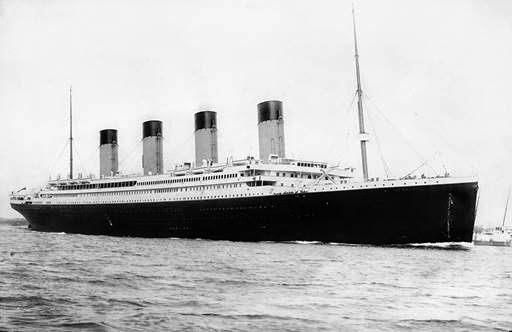
    2. The Red Cross aided those who survived the sinking of the Titanic. 


    When passengers arrived in New York harbor following the sinking of the Titanic, the Red Cross was there in 1914 to help those who survived one of history’s deadliest maritime disasters. Red Cross also offered assistance to families who lost loved ones when the Titanic went down. Here’s one family’s story.

    3.  90% of the disasters the American Red Cross responds to are home fires.


    When many people think of the Red Cross, our relief efforts following natural disasters usually  come to mind first. But the Red Cross provides more assistance following home fires than after any other disaster. With nearly 2000 responses to home fires every year in this region, Greater NY is the busiest in region in the country for the American Red Cross. Make sure you are prepared for a home fire by checking out our Home Fire Safety and Prevention tips.

    4.  In the movie Ghostbusters, the Red Cross was at the ready to assist those affected by the Stay Puft Marshmallow Man.

    ezgif.com-optimize.gif

    Even the Ghostbusters need a little help now and then. You might have missed our cameo, but the Red Cross was there to offer comfort and care to Louis Tully and all affected by the Stay Puft Marshmallow Man, just like we do outside the silver screen.

    Just remember: When you need help in an emergency “who you gonna call?” should still be 911, and right behind first responders you can expect to see a helping hand from one of our Red Cross volunteers.

    5.  The Red Cross can help you prepare for Godzilla and Sharknado.


    Being a Red Cross volunteer means being prepared and helping others prepare, even for disasters as unlikely as Godzilla and Sharknado. Previous Red Cross blog posts have helped get residents ready for both.

    We recommended having flashlights, batteries, food, water, and maps in case of these emergencies and a safe place to meet your family in case you are split up. Our Red Cross Emergency App is another great resource to prepare for the unexpected.

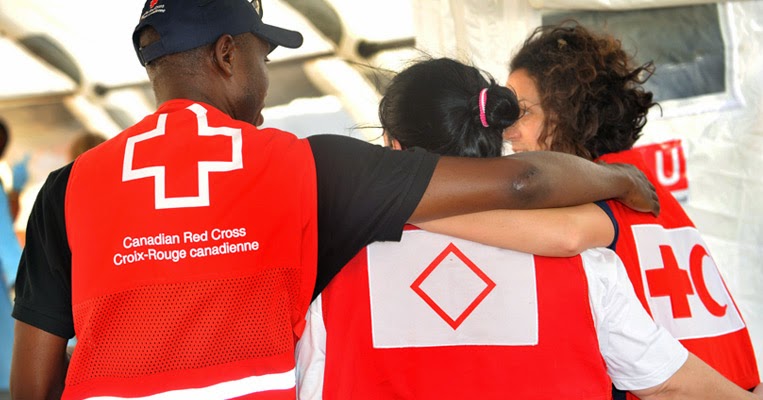
    6.  There are THREE symbols that represent the Red Cross Network Globally.


    Along with the Red Cross symbol, did you know the two other symbols used by our global network? The Red Crescent was formally recognized in 1929 and today is used by 33 of the 189 recognized societies worldwide. The Red Crystal is another neutral symbol of the Red Cross, formally recognized in 2005.


    7.  During the Northeast Blackout of 2003, the Red Cross responded to more than 70 fires.


    The Northeastern blackout, the world’s second-most widespread blackout, affected about 45 million people in eight U.S. states. While Red Cross response teams were out helping stranded commuters, volunteers were also providing assistance following more than 70 home fires. To put things in perspective, on average, the Greater NY Red Cross responds to seven local emergencies every day. Why so many fires in a short period of time? Unsafe use of candles was one reason. Click here for Red Cross Tips on coping with power outages.

    8.  The American Red Cross accepts vehicle donations.


    The Red Cross doesn't only accept money, we are able to receive vehicle donations as well. As a donor, the program provides a cost-free way to dispose of your unwanted vehicle while getting a tax deduction. Donating your vehicle is another great way to help us help others.

    9. The International Red Cross has won 4 Nobel Peace Prizes.


    Henri Dunant, founder of the International Red Cross, was the co-recipient of the first Nobel Peace Prize in 1901 for his humanitarian work. Since then, the Red Cross has won the honor three other times: 1917, 1944 and 1963.

    10. Red Cross is a part of the United Nations.


    The global Red Cross network is represented at the United Nations. Two branches of the Red Cross--the International Committee of the Red Cross (ICRC) and the International Federation of Red Cross and Red Crescent Societies (IFRC)--advocate for our humanitarian principles on the world’s largest stage, right here in NYC. Click here to learn more about their work at the UN.

    11. Volunteers constitute 90% of the total workforce of the American Red Cross.


    Red Cross volunteers fulfill many roles, from providing assistance following home fires,to teaching CPR, to installing free smoke alarms, to coordinating blood drives,to serving as board members and so much more. Since we are dependent on our volunteer force to carry out most of our humanitarian work, volunteers enable us to carry out our mission in NYC and beyond. Across the organization, the Red Cross has an average of 14 volunteers to every employee.

    If you’re passionate about helping people and looking to volunteer with a visionary humanitarian organization, you can make a difference with the Red Cross by becoming a volunteer today.

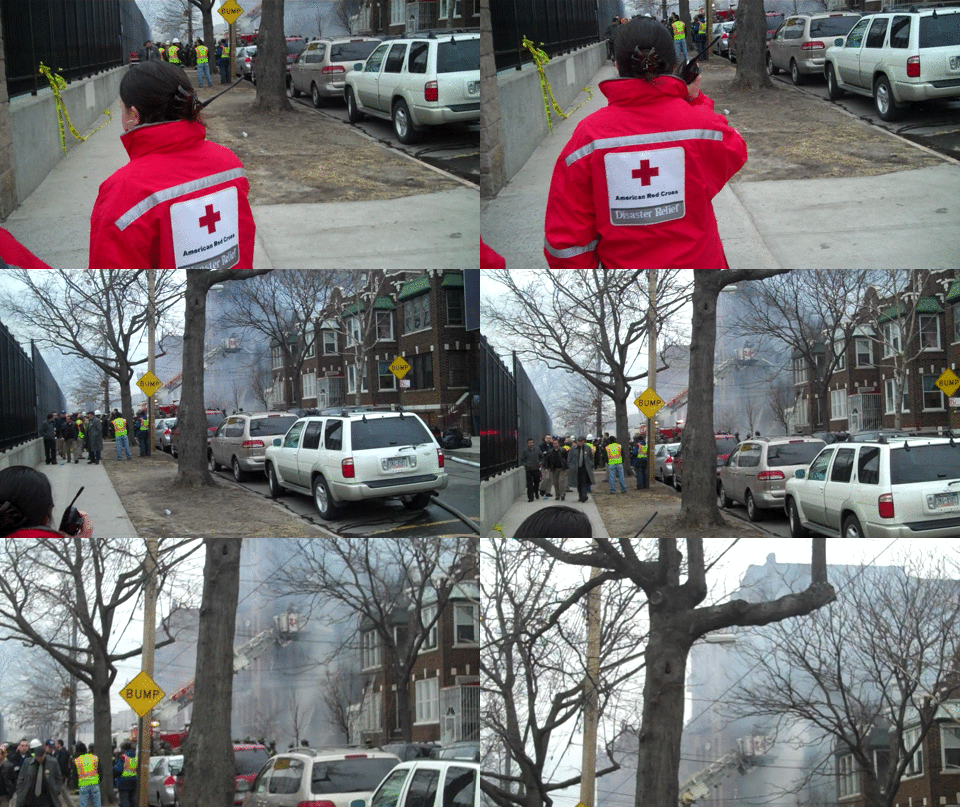
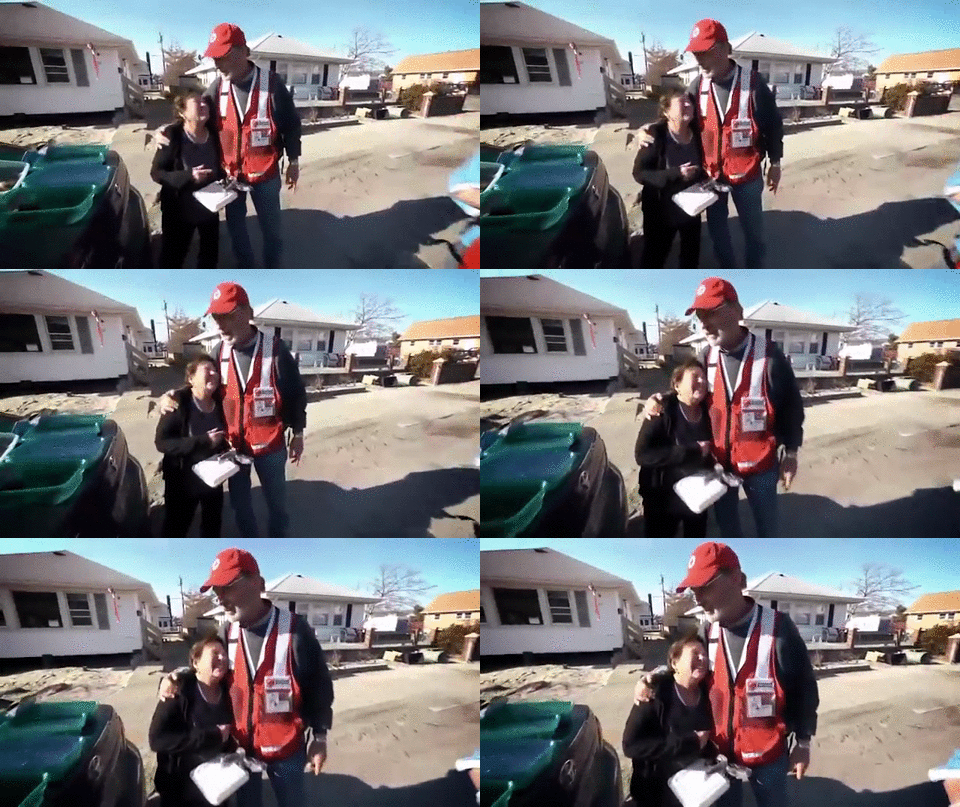
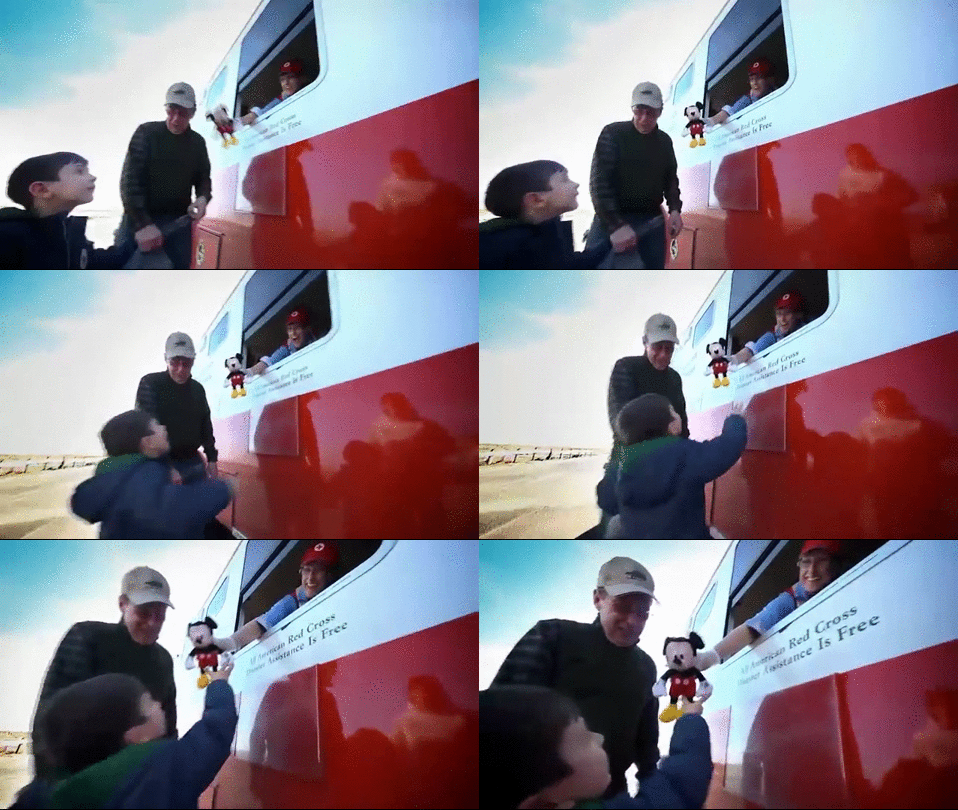
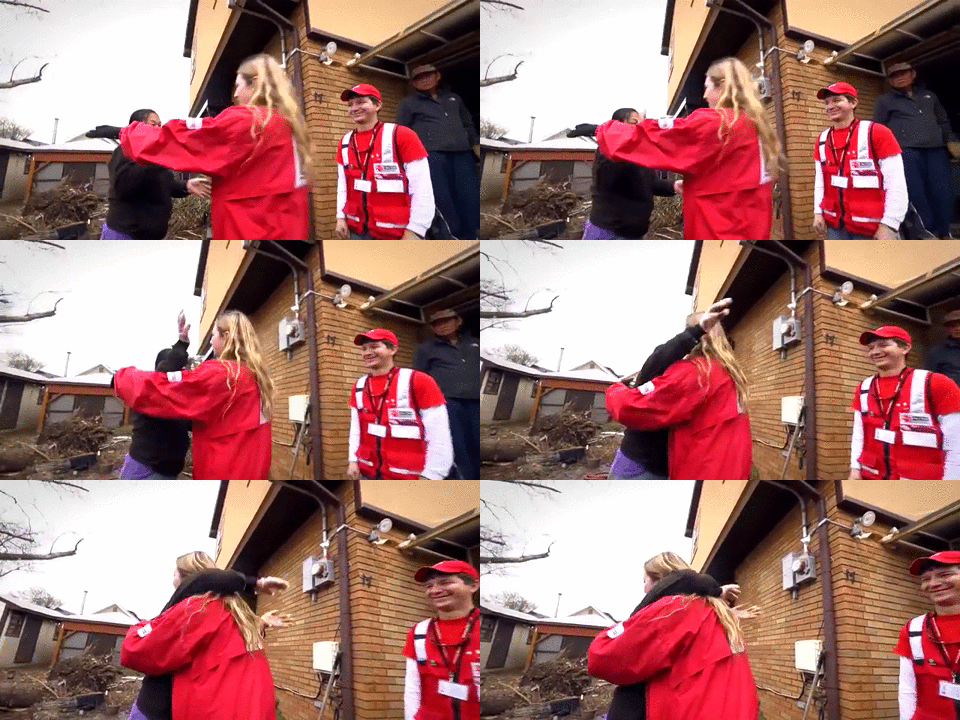
    12. Every eight minutes in this country, the Red Cross responds to a disaster, providing food, shelter and comfort.

    ezgif.com-gif-maker.gif

    ezgif.com-crop.gif  


    ezgif.com-gif-maker-2.gif

    To learn more about the Red Cross mission and how you can join us, visit www.redcross.org.

    Note: Yes, we realize that Rick Moranis appeared twice in this blog post.